The World's Oil Chokepoints: Where 90% of Seaborne Crude Actually Flows
About 70% of global oil demand moves through just eight narrow maritime routes. Here is the interactive map of where crude actually flows in 2025 - and why Malacca, not Hormuz, tops the list.
Roughly 70% of global oil demand - and more than 90% of seaborne oil trade - passes through eight narrow maritime routes. A tanker leaving a Saudi port for a Rotterdam refinery traverses at least two of them, sometimes three. Disrupt one, and the rerouting alone costs weeks and millions per voyage.
Here is the map of where global oil actually flows in the first half of 2025, with each chokepoint sized by daily throughput. Hover a bubble for detail.
Source: U.S. Energy Information Administration, first half 2025.
The ranking
| # | Chokepoint | Oil flow (mb/d) | Share of seaborne oil |
|---|---|---|---|
| 1 | Strait of Malacca | 23.2 | 29% |
| 2 | Strait of Hormuz | 20.9 | 27% |
| 3 | Cape of Good Hope | 9.1 | 11% |
| 4 | Suez Canal + SUMED | 4.9 | 6% |
| 4 | Danish Straits | 4.9 | 6% |
| 6 | Bab el-Mandeb | 4.2 | 5% |
| 7 | Turkish Straits | 3.7 | 5% |
| 8 | Panama Canal | 2.3 | 3% |
The routing double-count
Add these numbers up and you get roughly 73 million barrels per day - far more than the ~46 mb/d of oil that is actually traded at sea globally. The difference is not an error. It is routing. A barrel leaving Saudi Arabia's Ras Tanura bound for Rotterdam passes through both Hormuz and Bab el-Mandeb (then Suez). A barrel taking the long way around Africa passes through Hormuz and Cape of Good Hope. Every chokepoint counts every barrel that crosses it.
Why Malacca, not Hormuz, leads
Malacca is rarely in the news - yet it carries more oil than Hormuz. The reason is geography: every tanker moving oil from the Middle East or Africa to China, Japan, South Korea, or Taiwan squeezes through this roughly 1.7-mile-wide waterway between Malaysia and Indonesia. The volume is enormous - over 102,000 ships transited Malacca in 2025, up from 94,300 in 2024 - but the strait has not been politically contested the way Hormuz has. That is why Malacca stays quiet despite its scale.
Why Hormuz gets the headlines
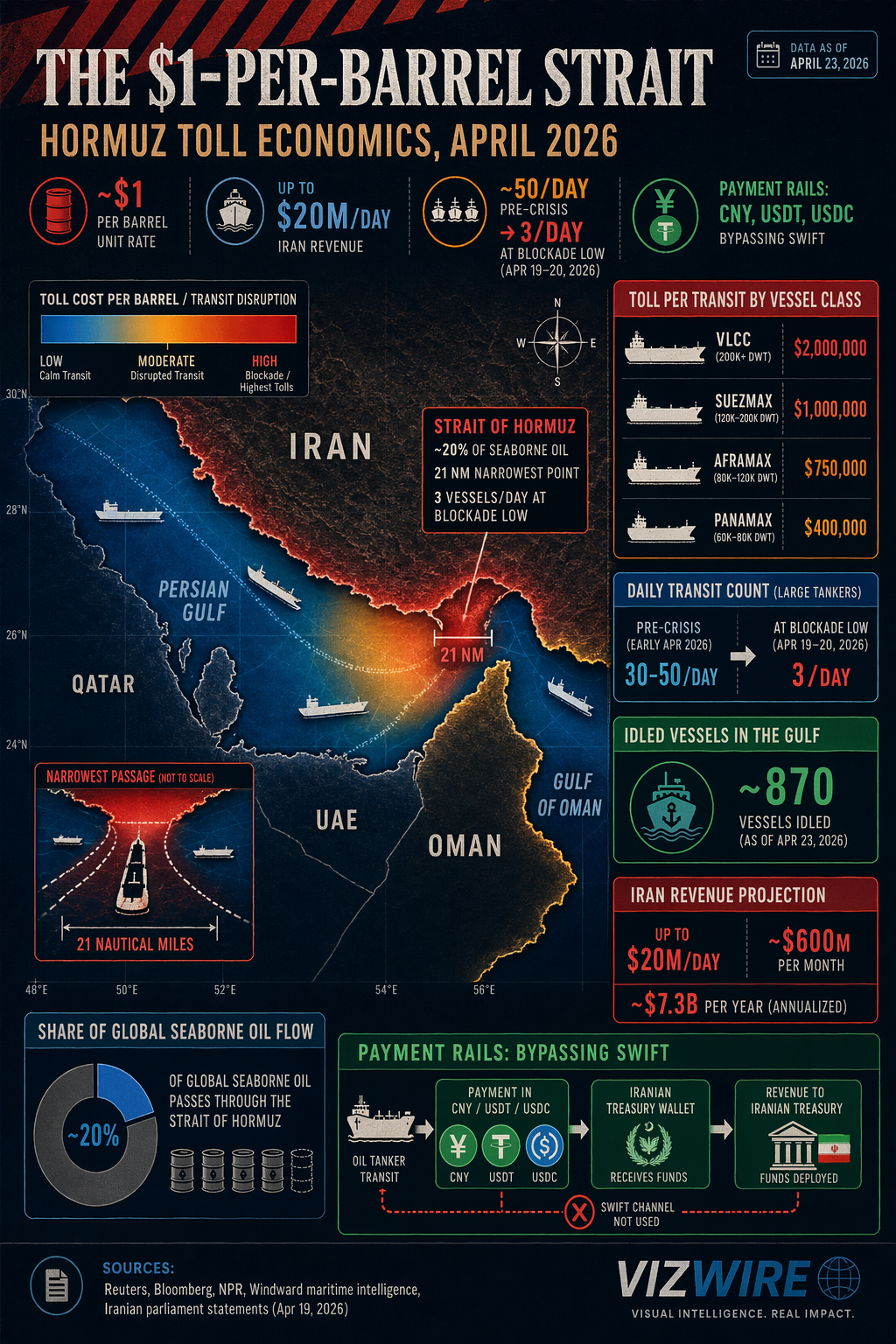
Hormuz's oil share is slightly lower, but the geopolitics are entirely different. The strait is controlled on one side by Iran, a state with both the intent and capability to disrupt transit - and in 2026, the willingness to charge tolls for it. Our companion piece walks through what that toll regime looks like in practice.
The Cape of Good Hope: the release valve
The #3 chokepoint is not really a chokepoint at all. It is where oil goes when other chokepoints fail. Its 9.1 mb/d flow today is sharply elevated by Red Sea disruption (Houthi attacks in 2024, spillover tensions since). When Bab el-Mandeb closes, Cape of Good Hope opens. The two numbers move in opposition - a useful reminder that the global system has release valves, just slow and expensive ones.
What a real disruption looks like
No single chokepoint closure can stop global oil trade. But a coordinated disruption at two or three - Hormuz plus Bab el-Mandeb, for example - forces all Middle East oil to route via Cape of Good Hope, adding roughly two weeks of transit time per voyage and draining global tanker capacity. That scenario is what the rest of the oil market quietly prices in whenever the Middle East flares up. It is also why the Malacca Strait, however peaceful it looks on the map above, is the single greatest concentration of strategic risk in global energy logistics - not because anything is happening there today, but because if anything ever did, there would be nowhere else for a fifth of seaborne oil to go.
Sources
- EIA — World Oil Transit Chokepoints (overview)
- EIA — Amid regional conflict, the Strait of Hormuz remains critical oil chokepoint
- EIA — The Strait of Hormuz is the world's most important oil transit chokepoint
- US News — Hormuz Crisis Throws Spotlight on World's Largest 'Chokepoint' — the Malacca Strait
- Malay Mail — Strait of Melaka handles nearly a third of global oil flows
- IEA — Strait of Hormuz
- Visual Capitalist — Mapped: The World's Oil Chokepoints