Strait of Hormuz Toll Economics: Iran's $20M-a-Day Chokepoint Tax
Iran is now charging oil tankers to transit the world's most critical oil chokepoint. Here is the math, the mechanics, and why $1 per barrel is rewriting maritime norms.
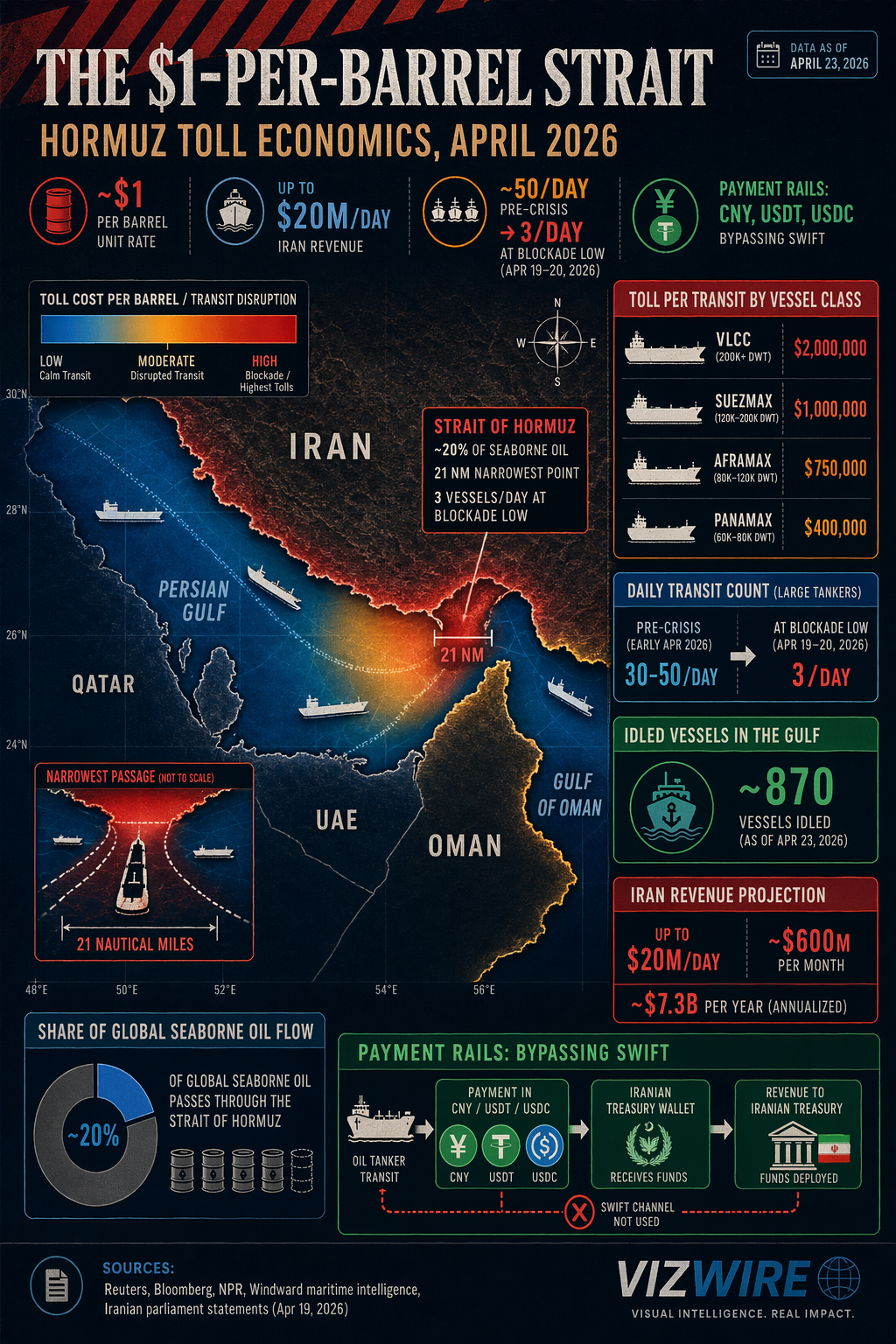
Roughly one-fifth of all seaborne oil passes through a 21-nautical-mile strait between Iran and Oman. As of April 2026, every one of those barrels has a new line item: a toll paid to Tehran.
The toll structure
Iranian authorities have set the price at roughly $1 per barrel of cargo, scaled by vessel size. Tolls are accepted only in Chinese yuan or dollar-pegged stablecoins (USDT, USDC) - deliberately bypassing the U.S. financial system and the sanctions framework that relies on it.
| Vessel class | Typical cargo (barrels) | Approx. toll per transit |
|---|---|---|
| VLCC (Very Large Crude Carrier) | ~2,000,000 | ~$2,000,000 |
| Suezmax | ~1,000,000 | ~$1,000,000 |
| Aframax | ~750,000 | ~$750,000 |
| Panamax product tanker | ~400,000 | ~$400,000 |
What Iran could collect
Analysts estimate the tolls could generate up to $20 million per day from oil tankers alone - roughly $600 million a month, or $7.3 billion a year if transit normalizes at the new price. That is meaningful revenue for a sanctioned economy that cannot easily access the dollar system for its own exports.
The shipping crash
Before the crisis, the Strait handled one of the densest tanker flows on earth - frequently 30 to 50 large oil vessels per day. By April 19 to 20, daily transit had collapsed to just 3 vessels, the lowest level since the blockade began. Roughly 870 ships remain idled or holding position in the Gulf, waiting either to pay, to negotiate, or for the situation to clear.
Payment rails designed to dodge sanctions
The two accepted payment methods matter as much as the toll itself:
- Chinese yuan (CNY) - settlement through Chinese banks and Iran's yuan-denominated accounts.
- Dollar-pegged stablecoins (USDT, USDC) - blockchain settlement that routes around SWIFT and U.S. correspondent banks.
Neither channel requires the consent of Washington, London, or Brussels. That is the point.
The legal shift
On April 19, the head of the Iranian parliament's construction committee confirmed a bill under consideration that would make the toll regime permanent: vessels from "hostile" countries would be barred from the Strait entirely, while all others would pay. This is a deliberate departure from the UN Convention on the Law of the Sea, which guarantees transit passage through international straits without tolls or discrimination.
Why this matters beyond oil
If the toll becomes the new normal, it sets a precedent that any coastal state with a chokepoint - think Egypt, Turkey, Malaysia, Panama - might try to replicate. Global shipping has been priced on the assumption of free passage through international straits since the mid-20th century. That assumption is being tested live, at the scale of roughly $1 billion per month, one tanker at a time.
Sources
- Washington Times — Iran says it is collecting transit fees in the Strait of Hormuz (Apr 23, 2026)
- NPR — The U.S. seizes another oil tanker as peace talks with Iran remain in limbo
- Bloomberg — Strait of Hormuz: Ships Paying Iran Yuan and Crypto Tolls For Safe Passage
- CNBC — Strait of Hormuz remains basically closed as Iran seizes ships
- Washington Times — Permanent Iran tolls on Strait of Hormuz would rock global economy
- Windward — Iran War Maritime Intelligence Daily (Apr 20, 2026)
- Wikipedia — 2026 Strait of Hormuz crisis
- Democracy Now — Headlines for April 23, 2026