The Rise of Remote Work: 2020-2025 in Numbers
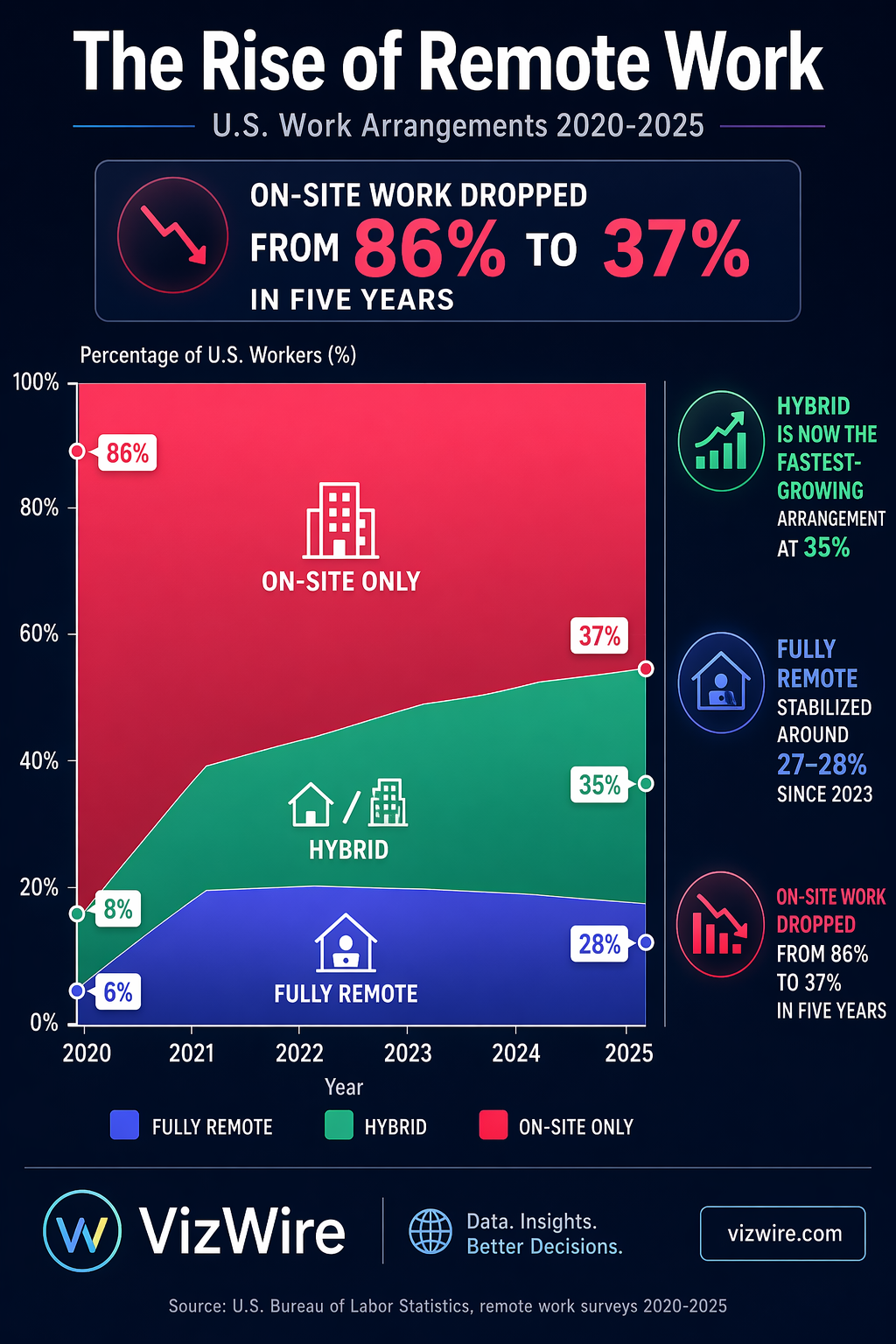
Five years of data reveal that remote work is not a pandemic blip — it is a structural shift. On-site work dropped from 86% to 37%, hybrid surged to 35%, and fully remote stabilized near 28%.
In early 2020, 86% of American workers commuted to a physical workplace every day. Five years later, that number has fallen to just 37%. The shift is not a temporary pandemic artifact — it is a structural transformation in how, where, and when we work.
The numbers tell a clear story
When COVID-19 forced offices to close in March 2020, only 6% of U.S. workers were fully remote. Within a year, that figure surged to 35% — the fastest adoption of a new work model in modern history.
But the real story is not the spike. It is what happened after.
Rather than snapping back to pre-pandemic norms, work arrangements settled into a new equilibrium. Fully remote work eased from its 2021 peak but stabilized around 27–28% — more than four times the pre-pandemic baseline. On-site-only work continued a slow, steady decline year after year, from 47% in 2021 to 37% in 2025.
Hybrid wins the long game
The most striking trend is the rise of hybrid work. Starting from just 8% of workers in 2020, hybrid arrangements have grown every single year, reaching 35% in 2025. It is now the fastest-growing work model and is on track to overtake on-site as the most common arrangement.
Employers and employees appear to have converged on hybrid as a compromise. Workers get flexibility without full isolation. Companies maintain some degree of in-person collaboration while accessing a broader talent pool.
The on-site decline is not over
On-site-only work has dropped from 86% to 37% in five years — a 49 percentage-point collapse. And the decline has not plateaued. Each year from 2021 to 2025 saw a further 2–3 point drop, suggesting the shift is still underway.
Industries that once seemed immune to remote work — manufacturing floors, healthcare settings, retail — have found ways to move at least some roles off-site. Back-office functions, customer support, and administrative roles are increasingly remote-first, even in traditionally on-site sectors.
Three key takeaways
- Hybrid is the new default. At 35% and climbing, hybrid work has become the arrangement most companies are designing around. Office space is being reconfigured for collaboration rather than daily desk work.
- Fully remote has a floor. After the 2021 spike, remote work settled near 28% and has held there for three years. The roles that can be done remotely are being done remotely — and that is unlikely to reverse.
- On-site is not dead, but it is shrinking. At 37%, on-site-only work is still the single largest category — but barely. If current trends hold, hybrid will overtake it within a year.
What comes next
The data points to a workforce that is still in transition. The rapid changes of 2020–2022 have given way to a slower but persistent shift. Companies that built return-to-office mandates around 2023 expectations may find themselves adjusting again as the talent market continues to favor flexibility.
The question is no longer whether remote work will last. It is how organizations will adapt to a world where fewer than four in ten workers show up to an office every day.
Source: U.S. Bureau of Labor Statistics, remote work surveys 2020–2025