AI at Work: From 11% to 38% Daily Usage in Two Years
Half of all U.S. employees now use AI at work. Daily usage has tripled since 2024. But the gap between who has access and who actually uses it reveals a deeper story about how workplaces are — and aren’t — changing.
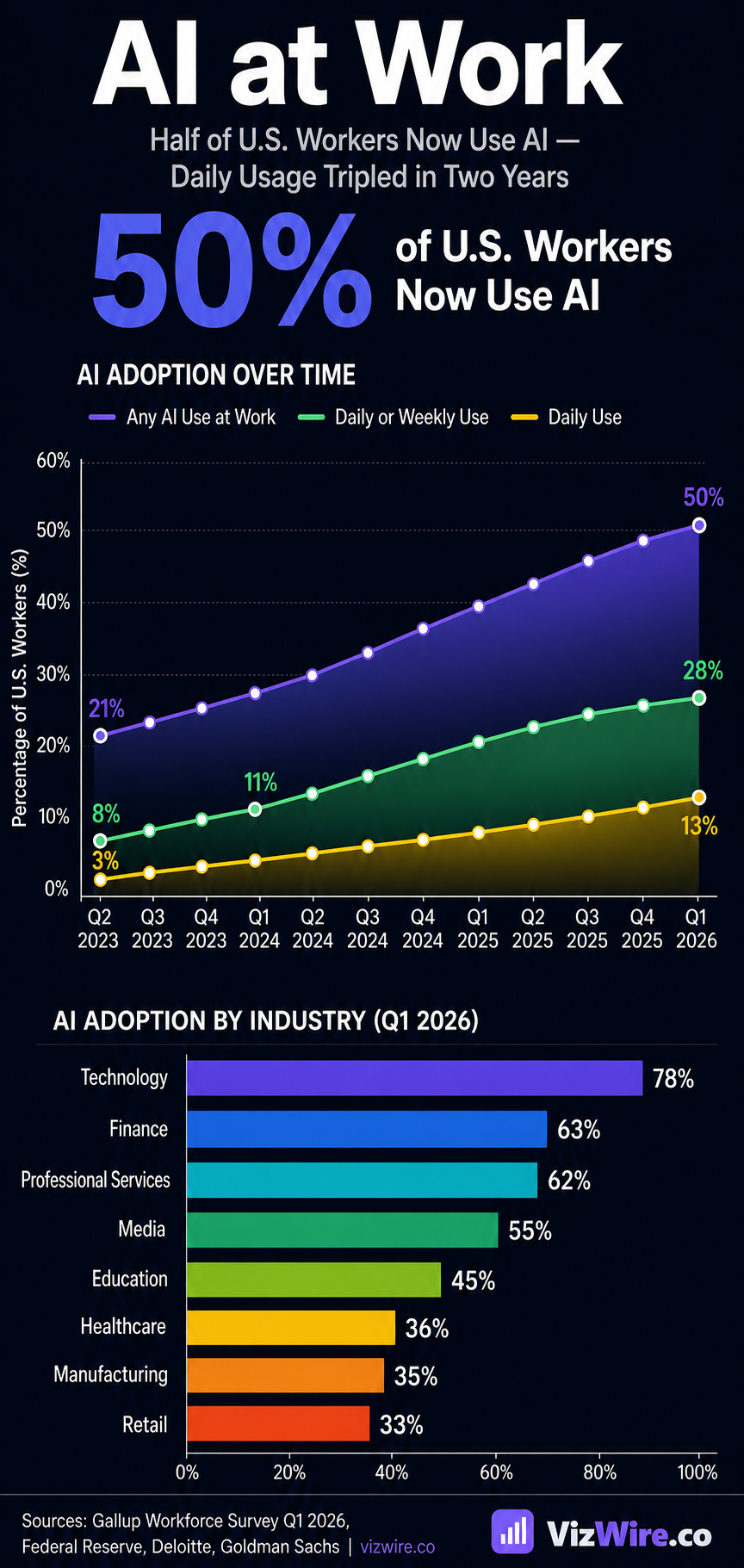
Back in mid-2023, about one in five American workers had tried AI on the job. Less than three years later, it’s one in two. Gallup’s latest data puts it at 50% — the first time it’s crossed that line.
Nothing in enterprise tech has moved this fast. Cloud took a decade to hit mainstream. Mobile took years. AI tools went from niche to normal in under three.
The adoption curve
Gallup’s quarterly numbers show the climb: 21% in Q2 2023, 50% by Q1 2026. But the more interesting shift is how often people are using it. Daily usage hit 13%, and daily-or-weekly reached 28%. Among knowledge workers, 38% now use generative AI every single day — that was 11% in 2024.
What workers are actually doing with it
People with ChatGPT enterprise accounts say they’re saving 40 to 60 minutes a day, per Goldman Sachs research from April. Three-quarters say they can now do things that weren’t possible before.
Here’s the thing, though. Goldman also found “no meaningful relationship between AI and productivity at the economy-wide level.” The real gains show up in two places — coding and customer service — where output jumps about 30%. Outside of those, it’s hard to measure much.
The access-usage gap
Deloitte’s 2026 State of AI report found that access to AI tools at work grew 50% in a single year. But having a tool available and actually opening it every day aren’t the same thing.
Gallup puts a number on this from the company side: 91% say they use AI somewhere in their operations, but only 26% of employees actually use it weekly. Companies aren’t short on AI tools. They’re short on people who’ve changed how they work.
The industry divide
Tech is way out front — over 75% of workers use AI at least sometimes. Finance and professional services are in the 60% range. But industries with more frontline workers haven’t caught up.
The Fed’s April 2026 analysis backs this up. Professional services and finance show firm-level adoption around 30–33%, with worker usage in the low 60s. Other sectors are well behind.
Who’s using AI by role
The split isn’t just by industry — it’s by job function too. Engineering and IT are close to universal adoption. Frontline and ops roles, not so much.
The global picture
The global picture is uneven. India’s out in front with 92% of workers using AI weekly. Japan’s at the other end at 51%. The U.S. lands at 64%, which puts it squarely in the middle of advanced economies.
The productivity paradox
This is the part that doesn’t add up yet. Workers say they’re saving an hour a day. The share of leaders calling AI “transformative” doubled in a year — from 12% to 25%, per Deloitte.
But the macro productivity numbers haven’t budged. Goldman calls it a puzzle. The Atlanta Fed projects total employment will drop less than 0.4% from AI in 2026 — it’s everywhere, but it isn’t replacing people. Not yet.
The likely reason: most AI use today is still augmentation, not automation. People draft emails faster, summarize docs, brainstorm. It saves time inside existing workflows, but it doesn’t kill the role. The transformation that CEOs keep bringing up on earnings calls hasn’t hit the org chart yet.
What comes next
Deloitte found 85% of companies plan to deploy custom autonomous AI agents. Only 21% have governance frameworks that are actually ready for that. The next phase — AI that acts on its own instead of helping a person — is already being planned, mostly without guardrails.
So where does that leave us? AI at work passed the tipping point in early 2026. Half the workforce uses it, a third of knowledge workers use it every day, and the time savings are real. But there’s still a wide gap between having the tools and truly changing how work gets done — and an even wider one between individual gains and anything showing up in the GDP data.
Sources: Gallup Workforce Survey (Q1 2026), Federal Reserve FEDS Notes (April 2026), Deloitte State of AI in the Enterprise (2026), Goldman Sachs AI Adoption Tracker (March-April 2026), WalkMe, Worklytics, DataReportal, NBER, BCG.