The AI Reality Check: OpenAI Misses Targets as $300B Floods In
OpenAI missed its own revenue and user growth goals just as investors poured a record $300 billion into AI startups in Q1 2026. The gap between AI hype and AI revenue is wider than ever.
On Monday morning, a single Wall Street Journal report did what months of AI skepticism couldn't: it made the market flinch. OpenAI missed its own internal targets for both revenue and user growth—and the ripple effect was immediate. Oracle dropped 5.5%. CoreWeave fell 5.4%. The Nasdaq slid nearly a full percent.
This happened the same quarter that investors poured a record $300 billion into startups globally—most of it chasing AI. The contradiction is stunning: the money has never flowed faster, but the company that started this whole gold rush just admitted it can't keep up with its own projections.
The Miss That Moved Markets
The WSJ report landed before the bell on April 28. OpenAI had failed to hit 1 billion weekly active users for ChatGPT by end of 2025—a target that, in hindsight, may have been more aspirational than strategic. It also missed multiple monthly revenue targets in 2026. The market's response was swift.
View raw data
| Stock | Change (%) |
|---|---|
| Oracle (ORCL) | -5.5% |
| CoreWeave (CRWV) | -5.4% |
| AMD | -4.0% |
| Broadcom (AVGO) | -4.0% |
| Nvidia (NVDA) | -2.8% |
| Russell 2000 | -1.15% |
| Nasdaq Composite | -0.9% |
Information technology was the worst-performing sector on the day. Semiconductors, chip equipment, and computer hardware led the decline. It wasn't just OpenAI partners getting hit—the entire AI supply chain took a beating, from data center operators to chip designers.
The Valuation-Revenue Gap
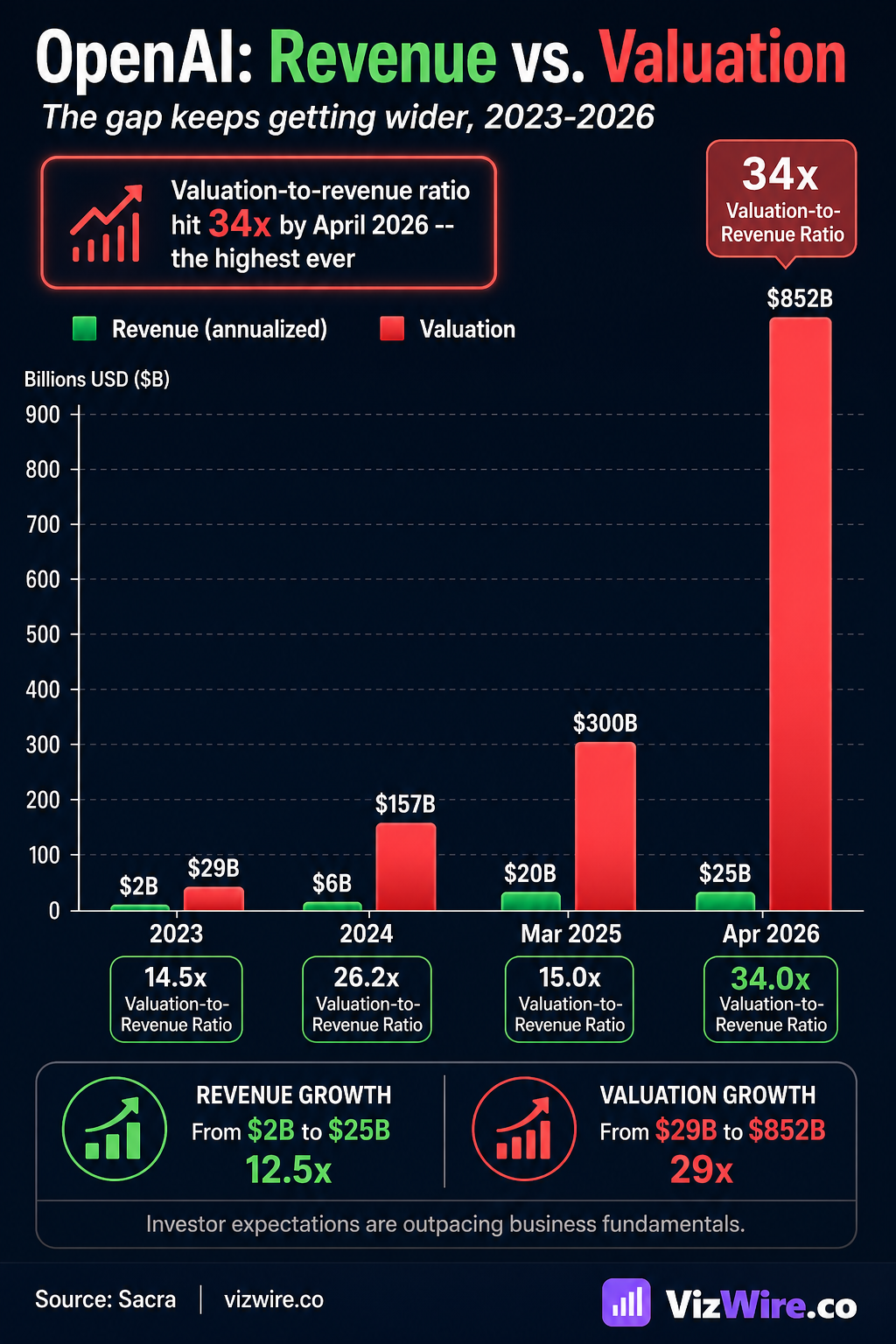
Here's the number that should keep investors up at night: OpenAI's valuation-to-revenue ratio just hit 34x. For context, that means investors are valuing every dollar of OpenAI's annual revenue at $34. The company went from $2 billion in revenue in 2023 to $25 billion annualized in early 2026—a genuine rocket ship. But its valuation went from $29 billion to $852 billion in the same period, growing far faster than the business underneath it.
View raw data
| Period | Revenue ($B) | Valuation ($B) | Ratio |
|---|---|---|---|
| 2023 | $2B | $29B | 14.5x |
| 2024 | $6B | $157B | 26.2x |
| Mar 2025 | $20B | $300B | 15x |
| Apr 2026 | $25B | $852B | 34.1x |
That 34x multiple isn't just high—it's the highest it's ever been. In March 2025, the ratio had actually dipped to a relatively sane 15x. Then OpenAI raised $122 billion in a single round and the valuation blasted past $850 billion. Revenue, meanwhile, inched from $20 billion to $25 billion. The math stopped making sense.
The $300 Billion Quarter
OpenAI's miss didn't happen in a vacuum. It happened during the most frenzied quarter of AI investment in history. In Q1 2026, investors poured $300 billion into 6,000 startups globally—more than 150% above any prior quarter. That single quarter represented roughly 70% of all venture spending in 2025.
But zoom in and the picture gets wilder. Four companies swallowed $188 billion—nearly two-thirds of the entire quarter's global venture capital.
View raw data
| Company | Amount ($B) | Share of Q1 Total |
|---|---|---|
| OpenAI | $122B | 41% |
| Anthropic | $30B | 10% |
| xAI | $20B | 7% |
| Waymo | $16B | 5% |
| All Others (~5,996) | $112B | 37% |
AI companies specifically captured $242 billion—80% of all venture capital deployed in the quarter. A year earlier, AI's share was 55%. And while those late-stage mega-rounds grabbed headlines, the seed market told a different story: dollar volume rose 31%, but the number of deals actually dropped 30%. Fewer bets, bigger checks. The concentration is intensifying.
The Race OpenAI Is Losing
Perhaps the most striking subplot in OpenAI's stumble is who's gaining ground. Anthropic—founded by ex-OpenAI researchers in 2021—went from $9 billion in annualized revenue at end of 2025 to $30 billion by March 2026. That's roughly 1,400% year-over-year growth. In the same window, OpenAI went from $20 billion to $25 billion. For the first time, Anthropic's run rate has overtaken OpenAI's.
View raw data
| Period | OpenAI ($B) | Anthropic ($B) |
|---|---|---|
| End 2023 | $2B | $0.2B |
| End 2024 | $6B | $1.5B |
| End 2025 | $20B | $9B |
| Mar 2026 | $25B | $30B |
The WSJ report specifically called out Anthropic's gains in coding and enterprise as a key reason OpenAI missed its monthly revenue goals. And Google's Gemini isn't standing still either—its rapid growth helped push OpenAI's annual ChatGPT revenue target out of reach in 2025. The AI market isn't winner-take-all anymore. It's a three-way fight, and OpenAI is no longer clearly in the lead.
The Cash Burn Problem
Revenue misses would be one thing if OpenAI were running lean. It is not. The company posted a 33% gross margin in 2025, dragged down by inference costs that hit $8.4 billion. Those costs are projected to swell to $14.1 billion in 2026. Total cash burn? An estimated $17 billion this year alone. The company doesn't expect to be cash-flow positive until 2030.
View raw data
| Year | Revenue ($B) | Cash Burn ($B) |
|---|---|---|
| 2022 | $0.3B | $0.54B |
| 2023 | $2B | $1.5B |
| 2024 | $6B | $5B |
| 2025 | $20B | $9B |
| 2026 (proj) | $30B | $17B |
And then there are the commitments. OpenAI has locked in roughly $600 billion in data center deals, including the $500 billion Stargate initiative and contracts with Microsoft, Oracle, and AWS. CFO Sarah Friar reportedly told company leaders she is worried the company might not be able to pay for future computing contracts if revenue doesn't grow fast enough. When your own CFO is flagging the math, the math deserves a closer look.
Cumulative losses are projected to reach $44 billion before the company turns profitable. That's not a typo. Forty-four billion dollars. And the planned IPO—a 2027 listing targeting a potential $1 trillion valuation—is now happening against a backdrop of missed targets and a CFO who reportedly disagrees with the CEO about whether 2026 is even the right time to file.
What This Actually Means
Let's be clear about what this isn't: this isn't a collapse story. OpenAI is still generating $25 billion in annualized revenue with 910 million weekly active users. Those are extraordinary numbers for a company that barely existed five years ago.
But the gap between AI's financial reality and AI's financial narrative has never been wider. Investors valued the top AI companies at well over $1 trillion on secondary markets while pouring $242 billion into AI startups in a single quarter. The numbers assume a future where these companies don't just grow—they grow at rates that have almost no historical precedent. And when the biggest player in the space admits it can't hit its own more modest targets, that assumption starts to crack.
The AI industry isn't in trouble. But the story the money is telling and the story the revenue is telling are two different stories. At some point, they'll have to converge. The only question is which one bends first.
Sources
- Sherwood News — OpenAI-linked stocks suffer after WSJ reports missed revenue and user targets (April 28, 2026)
- Crunchbase News — Q1 2026 shatters venture funding records as AI boom pushes investment to $300B (April 2, 2026)
- Sacra — OpenAI company profile: revenue, valuation, and funding data
- Sacra — Anthropic company profile: revenue, valuation, and funding data
- The Decoder — OpenAI misses revenue targets as Anthropic and Google close in (April 28, 2026)
- FutureSearch — OpenAI revenue, losses, and profitability: full financial breakdown
- Tech Funding News — Anthropic overtakes OpenAI with $1T secondary market valuation (April 23, 2026)