5.8 Billion and Counting: Mobile and Social Media Converge
For the first time, nearly as many people use social media as own a mobile phone. The digital planet just hit a tipping point.
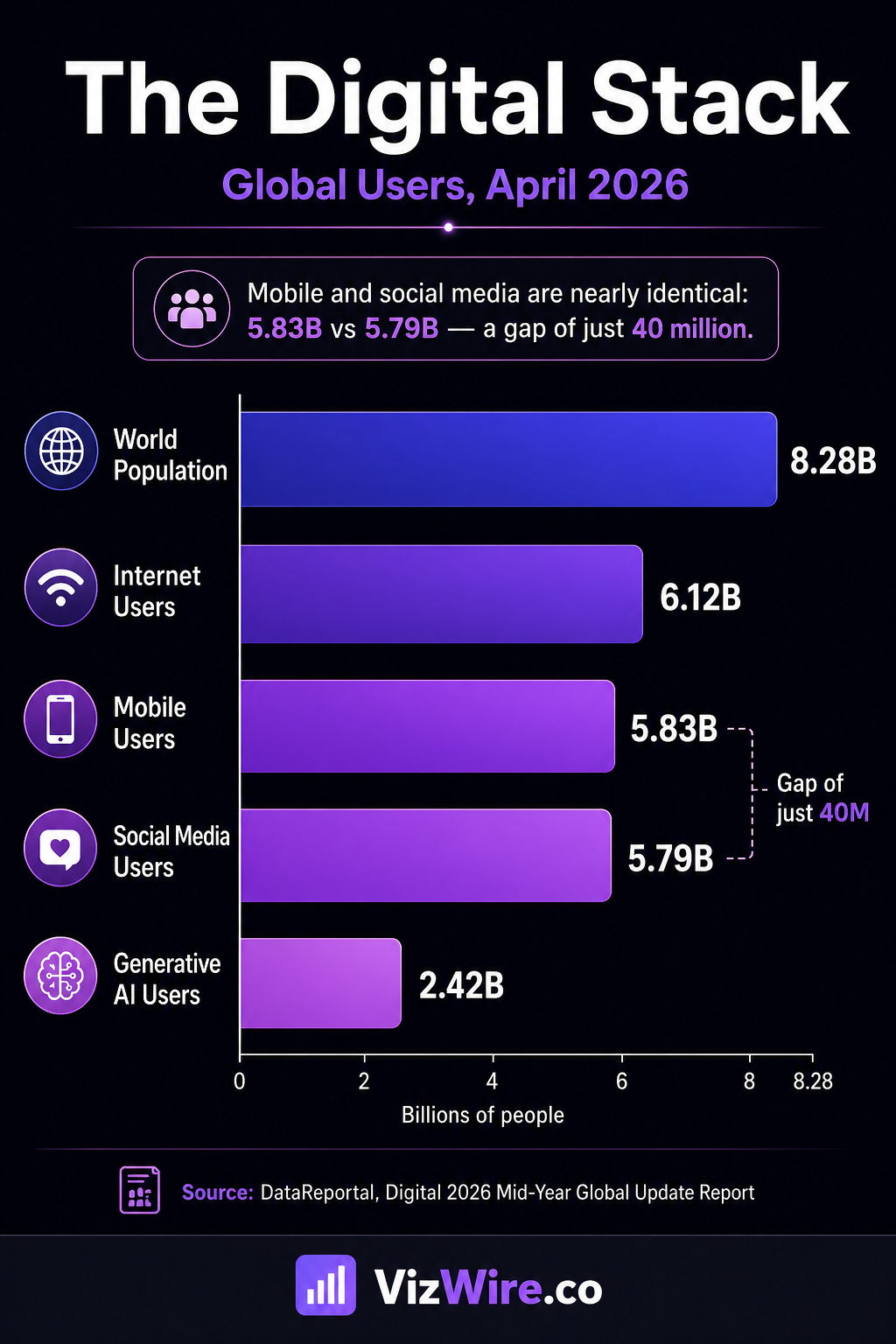
Sometime in the last few months, something quietly remarkable happened. The number of people on social media — 5.79 billion — crept to within spitting distance of the number of people who own a mobile phone: 5.83 billion. The gap between those two numbers is now just 40 million — less than the population of California. If you have a phone, you're almost certainly scrolling.
That convergence tells a bigger story than any single platform launch or earnings report ever could. It means the phone in your pocket is a social media device. Full stop.
The Digital Stack
Start with the full picture. Of the 8.28 billion people on the planet, 6.12 billion are online — that's 73.8% of humanity. Nearly all of them access the internet from a phone: 96.2% of internet users go mobile. And stacked right on top of that, 5.79 billion are on social media, with a fast-rising 2.42 billion already using generative AI tools.
Look at how tightly those middle three layers pack together. Internet, mobile, and social media are no longer three separate things. They're functionally the same behavior — just measured differently.
The Convergence That Wasn't Supposed to Happen This Fast
Back in 2017, there were 2.80 billion social media users. Mobile subscribers were already well past 5 billion. The gap was enormous — billions of people had phones but weren't on social platforms. Fast forward to April 2026, and social media has been growing at 5.4% annually — adding 294 million new identities in the last year alone. That's 9.3 new users every second.
Mobile growth, by contrast, has slowed to a crawl: just +1.8% year-over-year. The lines are converging because social is sprinting while mobile is jogging.
Here's the thing, though. That social media number — 5.79 billion — counts "user identities," not unique humans. Duplicate accounts, brand pages, and bots inflate the figure. But even accounting for that, the trajectory is undeniable. Social media went from a niche behavior to something two out of three humans on Earth do every month.
The Platform Landscape: Three Billion-User Clubs
Three platforms now claim 3 billion or more monthly active users: Facebook at 3.07 billion, and both Instagram and WhatsApp at 3 billion each. All three are Meta properties — meaning one company touches more humans monthly than any government, religion, or institution in history.
YouTube sits at 2.58 billion, and TikTok at 1.99 billion — just shy of the 2-billion mark it will almost certainly cross this year. Then there's a steep dropoff: WeChat at 1.41 billion, Telegram at 1 billion, and everyone else below a billion.
The average user doesn't pick one, either. According to DataReportal, the typical person bounces across 6.5 different platforms every month, spending 18 hours and 36 minutes a week doing it. That's more than a part-time job dedicated to scrolling.
The Great Divide
These global averages paper over a staggering gap. In Northern Europe, 97.5% of people are online. In Eastern Africa, it's 28.5%. That's not a digital divide — it's a digital canyon.
Social media penetration tells an even wilder story. Saudi Arabia clocks in at 111% — meaning there are more social media accounts than people. Meanwhile, Eritrea sits at 0.6%. One country has more accounts than citizens; the other has barely connected at all.
And it's not just a question of infrastructure. There's a gender gap, too. Globally, 75.7% of men are online compared to 70.7% of women — a gap of roughly 240 million more men than women online. In low-income economies, the disparity is far worse.
The 2.17 Billion Left Behind
For all the talk of a connected world, 2.17 billion people still don't have internet access at all. That's more than the entire population of China and the United States combined.
And the offline population isn't evenly distributed. India alone accounts for 440 million people without internet — followed by Pakistan at 139 million, Nigeria at 130 million, and China at 120 million.
This is the part that doesn't add up in the "everyone's online" narrative. Yes, 73.8% of humanity has internet access. But the remaining 26.2% are concentrated in the poorest regions on Earth, and internet growth has slowed to just 1.0% per year. At that rate, the last billion won't be connected for decades.
The AI Layer
And then there's the newest layer on the stack. Generative AI went from a curiosity to a mass medium in record time. As of April 2026, 2.42 billion people actively use GenAI tools — nearly 29.2% of the global population. That number more than doubled in twelve months, growing by 1.4 billion users. No technology in history has been adopted this fast — not the smartphone, not social media, not the internet itself.
To put it in perspective: it took social media roughly seven years to go from 2.80 billion users in 2017 to 5.16 billion in 2024. GenAI added 1.4 billion in a single year.
What the Convergence Actually Means
The shrinking gap between mobile users and social media users isn't just a statistical curiosity. It represents a fundamental shift in what a phone is. A decade ago, mobile meant calls and texts. Five years ago, it meant apps. Today, a mobile phone is a portal to a social layer that 69.9% of the planet participates in, where the average person juggles 6.5 platforms and spends more than 18 hours a week scrolling.
The next convergence is already underway. With 2.42 billion GenAI users and a 141% growth rate, AI isn't a feature that sits inside these platforms — it's becoming the interface itself. The question isn't whether AI will catch social media's scale. It's whether it will do it faster than social media caught mobile.
Based on current trajectories, bet on faster.
Sources: DataReportal, Digital 2026 Mid-Year Global Update Report • DataReportal, Global Social Media Statistics • DataReportal, Global Digital Overview • DataReportal, Digital 2026: Six Billion Internet Users • DemandSage • DemandSage, Internet User Statistics • Priori Data • World Population Review